
Mississippi Free Press: Liveblog of the Mississippi 2026 US Senate race – fascinating coverage of county updates and background articles.
Elections
There are 55 posts filed in Elections (this is page 1 of 6).
Election Law Blog: After a Few Days of Accepting Reality, Donald Trump Back to Calling Election Results into Question, Saying Dan Sullivan Won Alaska – screen caps of Truth Social posts – a counterpoint to Election Day comments from Trump
Anchorage Daily News: Like in past elections, Alaska is still counting ballots. When will we know who won? (via Election Law Blog) – more results should be available this week…
Josh Bernoff: The midterm election winners were the best communicators – Democrats articulated their message better than Republicans (sidenote: Lauren Kapp worked with James Talarico (more background here on Lauren).
Wired: Election Deniers Aren’t Contesting Their Massive Losses
Follow-up on the 2026 US general election and Oregon races
Overall, the Democratic Party had overwhelming success across the nation, taking control of the House and Senate in Congress. In addition, the federal government did not interfere in Election Day activities. Election Law Blog has several posts on this topic, suggesting that the preparation of state and local election leaders helped create an environment that supported voter access and stood ready to fight interference.
- Our Democracy Was Hanging By A Thread: Here’s How It Held (link)
- Vindication For Those of Us Who Said Throughout We Would have Free and Fair Elections Without Major Disruptions (link)
- Why the Trump Election Interference Strategy Failed (link)
- It Was Failed Election Meddling, Not Absence of Election Meddling (link)
Anne Applebaum for The Atlantic magazine also had thoughts on Election Day:
In my home state (Oregon), results generally favored Democrats. Democrat Tina Kotek had a 100,000 vote lead over the Republican Christine Drazen on Election Day with mail-in ballots still coming in through next week. With mail-in ballot volume since Election Day, it is very unlikely that Drazen can overtake Kotek, yet Drazen has refused to concede the race. As of November 6, Kotek’s lead has increased to 130,000 votes.
Two other races I was interested in were the US Senate race and the US House District 6 race. For US Senate, Democrat Jeff Merkley was running for reelection against Oregon House rep David Brock Smith. In past US Senate elections in Oregon, the Democratic incumbents Ron Wyden and Jeff Merkley have spent little effort to campaign in Oregon (advertising, candidate debates, other engagement). This happened again in 2026, but Merkley was able to easily beat Brock Smith (57% for Merkley, 39% for Brock Smith).
For the House District 6 race (a new district created in 2022), Andrea Salinas was running for reelection against former Dundee mayor David Russ. In her first two elections, Salinas faced businessman Mike Erickson. Both candidates spent quite a lot on negative ads. Andrea Salinas managed to win both times by 2-3% margins. In this year’s contest, David Russ raised about $15,000 versus $600,000 for Salinas. In this year’s race, Salinas had no advertising or engagement, yet she continued to send out almost daily fundraising texts – ugh! Even with Russ’ low financial support, he still managed to get 42% (with Salinas getting 57%). To me, this shows that there is a significant amount of Republican voters within the district, and that Salinas could face headwinds if a credible challenger could be found.
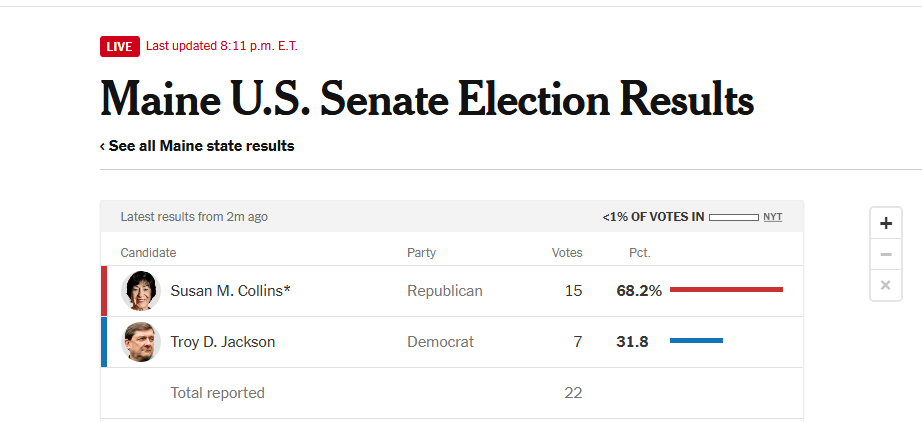
Possibly the earliest possible results from Maine:
Preparing for the US 2026 general election
There are a number of important elections happening around the world. In Brazil, Luiz Inácio Lula da Silva defeated Flávio Bolsonaro in their presidential election this past weekend. This past Tuesday, Israel held national parliamentary elections, which will determine if Benjamin Netanyahu will continue as prime minister. In the United States, early voting and mail voting is underway for local, state, and federal elections, culminating on November 3rd (Election Day in the US).
The most important step that voters can take is to vote early if possible, and be prepared to vote in person on Election Day if that is the voter’s choice (i.e., show up early with identification). What is at stake? The issue being covered in the mainstream media is control of the US Congress (currently the House and Senate have Republican majorities). Election polls are indicating that the Democrats could take control of at least the House, and perhaps the Senate as well.
The other issue that is getting a lot of attention is the possibility that Republicans could block Democrats from taking control of the House or Senate when the new Congress meets on January 3, 2027. Again, mainstream media are publishing a lot of negative “what-if” scenarios on how this could occur. I recommend following the Election Law Blog headed by Rick Hasen at UCLA Law School. This is an excellent resource on following any election-related litigation. In addition, there have been multiple posts evaluating these “what-if” scenarios at Election Law Blog and other sites on how the likelihood of success is low to none:
- Fearmongering about stealing Congress on January 3, 2027 (August 27, 2026)
- Can the Midterms Be ‘Stolen’ On Jan. 3? It’s Complicated. (August 2026)
- Can Congress Be Stolen from the Voters? (September 2026)
- How Trump Can—and Cannot—Still Mess With the Midterms (October 2026) (PDF copy)
- Taking the bait (October 2026)
- OK, Doomer – Trump can’t steal the midterms. ICE can’t be at the polls. A rogue clerk won’t tip the House. Our elections run smoothly – and this November’s will too (PDF copy)
Finding voting records on your state representative
Recently, I wanted to get information on the voting record of my representative in the Oregon House of Representatives. Oregon does have an online portal (Oregon Legislative Information System) to allow people to investigate legislation and voting records. From review of the online interface, it was easy to search for bills by bill number, and to get various information on those bills, but I did not see a way to get the voting record for my representative.
Fortunately, OLIS has an OData API to be able to create queries and get data from the system. Together with Claude Code, I was able to create several Python scripts to be able to get the voting record for a representative (House or Senate). I am linking to these scripts as Gists on Github for now, I am not sure yet if I want to create a repo for them. However, they may help others to have some examples to start their own investigations.
- getMeasures.py (get a list of bills)
- getEnactedMeasures.py (bills that have passed and become law)
- getVotesOnLaws.py
- getVotingRecord.py (get a voting record for a representative for a specific legislative session)
Remembrance of the 5th anniversary of the January 6th Insurrection
Here we are, five years later…some people would say that the insurrectionists won (Trump is back in office, Jan6 insurrectionists were pardoned). We still have a democracy, but it is heading towards authoritarianism. I hope the results will eventually head back towards democracy.
Previously on this weblog:
- My initial summary of the 2021 electoral count
- My impressions of Joe Biden’s inauguration
- My 2022 remembrance
- My 2023 remembrance
- My 2024 remembrance
- My 2025 remembrance
Other coverage:
- Frank McPherson
- Politico – Back in power 5 years later, Trump has all but erased the stain of Jan. 6
- NPR – This Jan. 6 plaque was made to honor law enforcement. It’s nowhere to be found at the Capitol
- New York Times – Jamie Raskin: Jan. 6 Never Ended
- Joyce Vance/Civil Discourse – January 6th Again
- Joyce Vance/Civil Discourse – The Dangerous Revision of Jan 6 History on the WH Website
- Garrett Graff/Doomsday Scenario – Five Ways to Remember January 6th
- CNN – The political divide over January 6 is only deepening five years after the deadly US Capitol attack
- US House of Representatives – Democrats hold a meeting to mark the fifth anniversary of the Jan. 6 attack on the U.S. Capitol.
- Jack Smith testimony transcript (also local copy)
- Video of Jack Smith testimony