
I just started seeing comments this past week on my WordPress blog that appear to be created by AI – is anyone else seeing this?
AI
There are 18 posts filed in AI (this is page 1 of 2).
Saw an interesting behavior in Claude Code
I have been working on a tool to access the sitemap of a news website to try to create feeds when the site does not provide feeds. The tool starts by reading the robots.txt file, which usually has a list of things that are “disallowed”. On one of the sites, it specifically included “Claude Code” in the “disallow” list. Claude told me that it could not run the tool, since it was on the disallow list, but I could run it, capture the output, then give it to Claude for further processing. This was the first time I have seen any “limit” imposed on Claude by itself – interesting!
My News Archive app is available here – check it out!
AI News Archive Project – Report 2 (app now available)
In Report 1, I mentioned how I was able to get an app working locally on my laptop within several hours. To recap, this is an app to collect news items exposed through feeds and create a searchable archive that can be used in research. In my next iteration of the app, I changed the database (MySQL to MariaDB) and deployed it on a server. The app is now available here (URL is temporary, trying to think of something besides some form of “newsarchive.com”, but that may be where I end up). I also had Claude create some user documentation which is linked at the top of the app.
For the most part, Claude provided the instructions for how to deploy the app and connect to the database, and the instructions were mostly correct. If the instruction failed, I pasted the error into the Claude terminal, and usually Claude came up with a correction. The biggest problem was trying to get a cron job set up to check feeds once per hour – the provided job entry was not working. After some web searches and Gemini checks/fixes, Claude figured out that part of the command left out a dash on a switch option – ugh! I hope that has been fixed now…
Issues that I have seen have been due to the input feeds (NYTimes feeds have some duplicate stories across their feeds). Also, since I have only been collecting data starting today, the archive is someone small, and only has feeds from two sources so far (NYTimes and ABC News). It was disappointing to find that CNN does not have feeds any more…. I am planning to work up to adding at least one new source a day, but will need to find feeds!
All feedback is welcome – give it a try!
Here’s a task where AI did a poor job
In a previous post, I mentioned that I asked Claude to collect RSS feeds for US newspapers. Here was the prompt:
Create a list of RSS feeds and save them using the following steps:
* Review all of the newspapers linked from this page (https://en.wikipedia.org/wiki/List_of_newspapers_in_the_United_States ), identify if they have a website, and make a list of the RSS feeds available from the website.
* Identify which newspapers do not have RSS feeds
* Identify which newspapers do not have websites
* Create a OPML subscription list of all RSS feeds identified and save this file to C:\Users\sylve\Documents\Claude_Projects\News_Archive
* Create a text file that lists the newspapers that do not have RSS feeds and save this file to C:\Users\sylve\Documents\Claude_Projects\News_Archive
* Create a text file that lists the newspapers that do not have websites and save this file to C:\Users\sylve\Documents\Claude_Projects\News_Archive
* Add the OPML and text files created to a new repository in my Gitlab account called news-archive
The result of this prompt was an OPML file with 386 feed URLs, but only 22 of them had any items. I looked at the first 5 feeds, and saw that Claude had taken the root URL of a site and added “/rss/” to the URL. There was nothing there. Why did Claude do that? Why did it not search on the site to find a valid feed, and if there was none, to add it to the list of newspapers that do not have feeds? If anyone has any insight into this, I would love to hear it.
AI News Archive Project – Report 1
In a previous post, I mentioned that my first AI project was to develop an application to create a archive of US newspapers based on RSS feeds. I initially used Claude Code to review a list of US newspapers from Wikipedia to search for websites and RSS feeds. As I posted earlier, this took several sessions to complete this task, and I had doubts that I would be able to create an app without hitting my Claude Pro token limit.
My next step was to create a Markdown document describing the app for Claude to use as starting point. I looked at several example product requirement documents (PRDs) and frameworks for developing apps using AI (Get Shit Done, Superpowers) to find a way to get started. Eventually, I decided to follow Peter Yang’s advice on developing apps:
- Don’t know what to build? Just tell AI your problems. Ask it: “What are some simple apps that we can build to help me take time back?”
- Create a robust plan first. Ask it to “Create a plan with 3 clear milestones” to avoid mistakes during coding. Spend half your time planning with AI.
- You’re the manager, AI does the work. Give it feedback and direction like you would a human employee. Be patient with it
I created a initial plan based on some PRDs I found in Peter Yang’s Github repo. I then asked Claude to review the plan and see if there was anything missing or not clear. Claude responded with a set of 12 things to change and 4 questions before starting any build work – wow! I accepted Claude’s suggestions, provided answers to the 4 questions, and Claude updated the plan (see here).
In the updated plan, four milestones were identified. Claude was prompting me to say “start building milestone 1”, so I did it. Claude then took 10-15 minutes to create code and tests for the Milestone 1 content. I decided to have Claude confirm steps with me as it went, so I could see issues firsthand (and there were issues, but Claude figured them out). If I had “let it run”, it might have finished quicker. During the Milestone 1 work, Claude was able to figure out that I had Wampserver installed on my local machine (which has MySQL, a specified part of the app tech stack), and used that to create the MySQL database for the app. When Milestone 1 development was complete, I did some operations with the app, then told Claude to create a handoff document (handoff.md) in case I hit a token limit during the session.
I then repeated this cycle for Milestone 2, 3, and 4. The handoff document was updated after each milestone. It turned out that I did not encounter any token limit. When the development was complete, Claude then added all of the code/files to a Git repo in the working directory. Here are some screenshots:
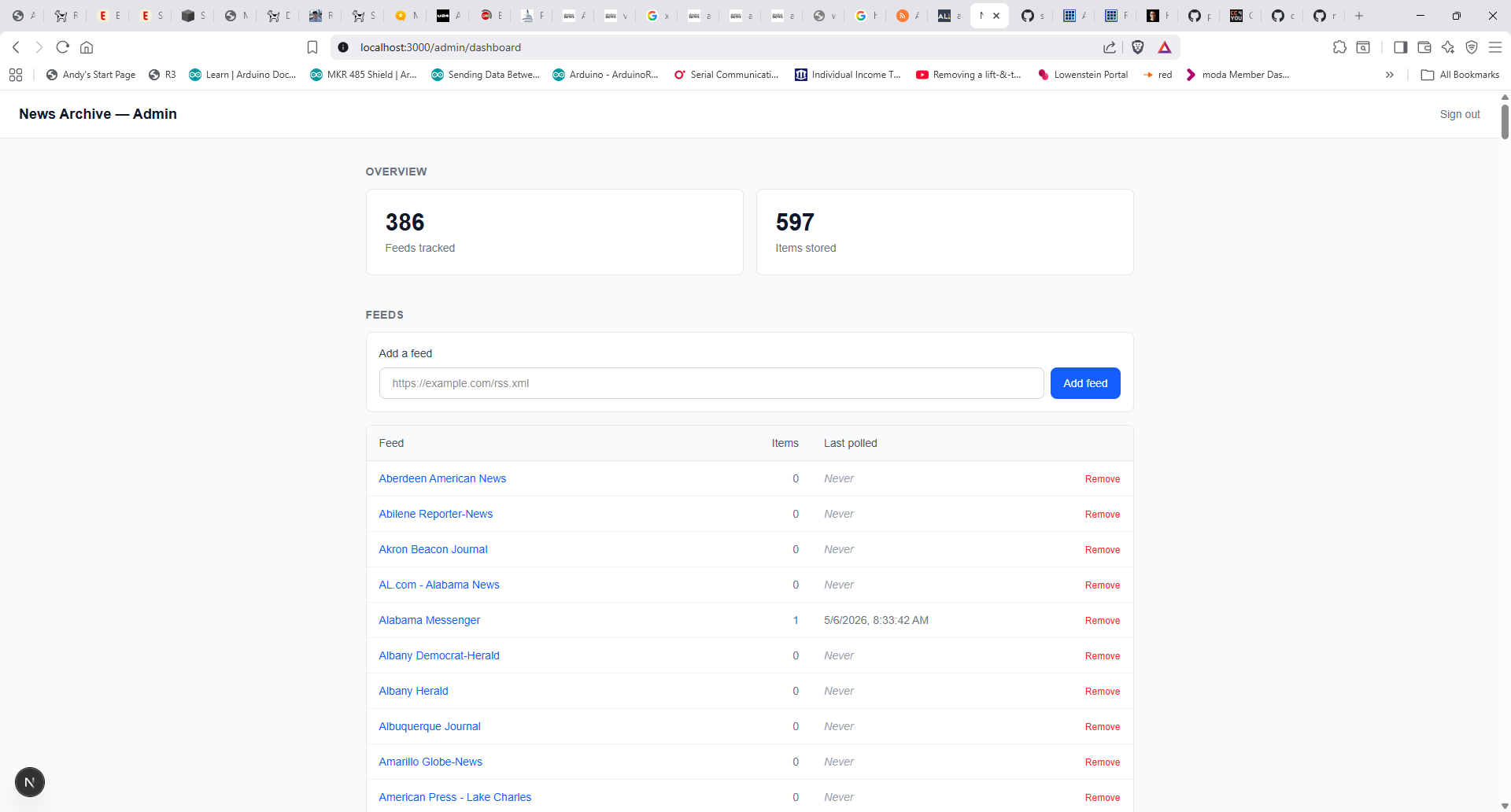
App admin screen
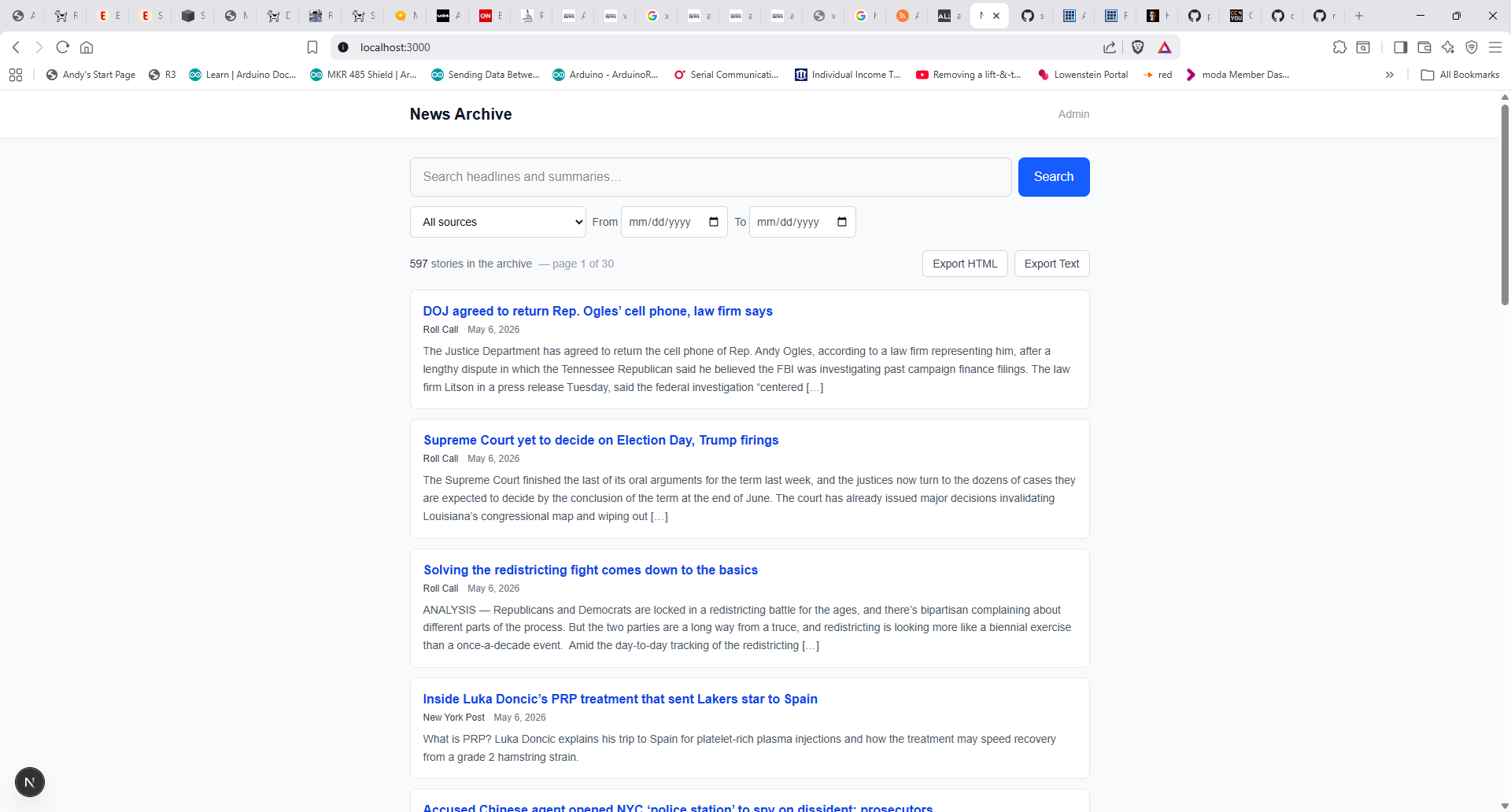
App search screen
To me, this was very impressive. It took less than 2 hours to get to this point – a fully functional application with 79 passing tests – amazing! I will post more when I have a version of the app running on a server.
PS – I have created a new category for these posts (AI for Smart Old Farts), if you want to just read these posts.
Some notes on Claude Code usage limits
In my previous post, I mentioned I started a task to identify RSS feeds for US newspapers. It took three Claude sessions to complete (hit token limit three times before completing the main part of the task). This was a bit of an eye-opener (I have a Pro subscription ($20/month)). Based on that, I am considering trying to run a LLM manually (see this YouTube video for one way to do this). I will post on this after I try it out.
My first AI project
I have watched a number of tutorials on using Claude Code, and I am still working through the Claude Code for Everyone course. After some thought, I have decided on my first project that I would like to develop using Claude. Over the past few years I have been involved in several projects (Portland Protest News, Kamala Campaign Timeline, and Liveblog47) where I was monitoring multiple news sites/feeds for a specific topic. In performing the research for these sites, I spent a fair amount of time reviewing sites/feeds, deciding what to publish, looking for other stories if the sites/feeds I was monitoring did not have what I needed. Having an agent to be able to do this would be a help. Also, it was difficult to research/locate other stories that were not current (published in the last day or two).
I am going to start with creating an application to collect stories/posts based on RSS feeds and create an archive of news for the United States. Next, I will provide an interface for researching that archive. I am starting with collecting RSS feeds for newspapers and news media sites within the US. This will probably take a bit of time (already ran out of tokens in my current Claude session), but it will give me time to plan out the next steps.
If anyone is interested on collaborating on this project, let me know!
Starting my exploration of AI
Now that I am retired, I am taking some time to explore AI tools, specifically Claude from Anthropic. In my previous job, I used Google Gemini for answering questions on tool setup/options, or creating short one-off scripts for repetitive tasks. However, these were all performed using ad-hoc prompts, and I wanted to learn how to use CLIs to create things.
I signed up for a Claude Pro subscription, and started a free course called Claude Code for Everyone (created by Carl Vellotti). The first module was an overview of how Claude can analyze files, extract and summarize data, and several other features. The second module was a first step at “vibe coding” – creating an online quiz. Claude created the code, added a repo to my Github account, then deployed it to Vercel (see the quiz here). In many ways, this is a contrived example, but a good way to get my feet wet with this kind of tool. Now I need to think of some apps to create!
Followup on the future of AI
Yesterday, Om Malik summarized some feedback on the Matt Shumer post that I linked to yesterday.
This whole drama, from the viral post to the takedowns to the counter-takes, none of it is really about Shumer’s essay. What it’s about is simpler. And harder to admit. In the words of screenwriter William Goldman, “Nobody knows anything.”
Shumer writes his breathless warning. Marcus writes his skeptical rebuttal. Kahn points out the flawed assumptions. Goldman notes the difficulty of separating signal from hype. And every one of them is also selling something. A book. A newsletter. A reputation. An audience.
Hmmm…sounds like we are all “on our own”….