Other examples of inbound/outbound RSS support

Dave Winer pointed to Ricardo Mendes from his linkblog on July 10 with the title “Inbound and Outbound RSS”. I took a look at the Mendes post, he describes using Indiekit and plugins to both read and write posts. I think this is very similar to my minimal blogging tool MyStatusTool. In the Mendez setup, it sounds like he is also reading feeds that do not include rssCloud support.

Mendez also mentions work by Aaron Parecki on the Monacle social feed reader/writer. This tool used the Micropub and Microsub specs for publishing and subscribing. The above link is from 2016, so you can see that this predates both the MyStatusTool and rss.chat tools.

What are the attributes of a “social platform”?

On June 28, 2026, Dave Winer put out a call for social web app developers to work with him if they are including inbound and outbound RSS in their apps. Manton Reece from Micro.blog referenced this in a post on Micro.blog, and had this statement: “I’m actually not aware of any social platforms that support inbound RSS except Micro.blog. It would be great to have more.”. Dave Winer then responded on Micro.blog as follows (partial quote):

I want a world of social platforms that support inbound RSS

Those two posts caught my eye, specifically the word “platform”. Why did they choose the word “platform”? That made me wonder – is this really a call for “centralized” services like Bluesky/Mastodon to add inbound RSS (to allow users to post within these services as “first class citizens” (as if they were posting within official apps for Bluesky/Mastodon))? In earlier comments on this topic, I wrote:

I have addressed this second objection before, stating “What is in it for the “other people’s software developers to add inbound and outbound RSS support”? My answer is – nothing – no users are demanding this – no users are clamoring for a RSS-based “social network” that can communicate as a peer with other social network software.

I had developed a web app in 2023 called MyStatusTool, and this app allows users to follow RSS feeds that support rssCloud (inbound RSS) and allows the user to create their own posts with a feed (outbound RSS). However, I had not thought about the following/display of other RSS feeds as “inbound RSS” until now.

I created this app because back in 2022, Dave Winer kept talking about creating an app that could do this, but he did not actually do anything about it, so I decided to do it! The one feature this app does not have is support for replies/following threads, which “platforms” like Bluesky, Mastodon, and Micro.blog support. Perhaps that is a key “attribute” of a “social platform”….

From recent posts, I am aware that Dave Winer is “working on something” with RSS and rssCloud to create some chat application. Hope he releases it soon! Hope it has inbound and outbound RSS!

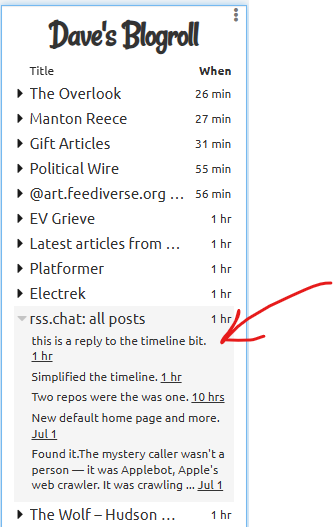
Does Dave Winer really want a RSS-based social web?

I am sorry to have to continue this thread, but there are more developments to assess. In a followup, Dave Winer shares he does not get much in the way of views of his content on Twitter. He then tells Ben Werdmuller (and the rest of us) that “we have to create our own social web”.

Well, there’s the rub, isn’t it! If someone wants to have a social web based on RSS, they are going to have to create it themselves, instead of trying to “boil the ocean” and get every other social network software platform to add features to use RSS as the transport mechanism for social network applications. Then, they are going to have to convince other people to use it instead of existing social network software.

From the Mastodon About page, Eugen Rochko created Mastodon in 2016 because he was “dissatisfied with the state and direction of Twitter”. That was 9 years ago! Mastodon as an application has taken a long time to reach the position it holds today. rssCloud has been supported in Dave Winer’s blogging tools since 2001, and rssCloud support was added to WordPress in 2009 (see reference here), but there has been almost no uptake of rssCloud as a basis for blogging or social network tools. Perhaps part of the reason why is how Dave Winer responds to negative feedback on his tools in a negative way (examples: Feedland and Drummer).

I have described what a social network should have, and that definition covers all current social networking applications. Dave Winer gave his own description of a RSS-based Twitter app in January 2025, and it matches up pretty well with the app I developed, My Status Tool (demo version, repo for code). I also created a portal site for RSS-based apps for social networking (The Feed Network), so there is a place for people to get started (but I do not see it as my mission to try to evangelize this area). Dave has talked about what his new vision would be using WordLand (September 2025), but this “new vision” is nowhere to be seen. Show us the beef!

Do users want a “Really Simple” social web?

I have refrained from commenting on updates from Dave Winer regarding Inbound RSS, two-way RSS, social web based on RSS…fill in the blank RSS…, since he did not do a “reveal” on any of the features he said he was going to demo at WordCamp Canada 2025. However, this weekend, he posted another mini-manifesto on RSS-based social web stuff, which deserves a review.

He references three posts by notable writers who have written posts on RSS in the past year. Of the posts, only one hints at more “social web” possibilities for RSS. The overwhelming majority of the content of the posts concerns the classic reasons for using RSS (control the content you read, control the way you read it, filter out shit). So – my first objection to this manifesto is that these prominent users are not sending out calls to action demanding “inbound RSS” or “using RSS as a social network”. The second objection I have is the demand that other people’s software should start supporting two-way RSS (Davespeak for “inbound RSS” and “outbound RSS”). This is nothing new from Dave Winer, but none of these three references say anything at all about this.

I have addressed this second objection before, stating “What is in it for the “other people’s software developers to add inbound and outbound RSS support”? My answer is – nothing – no users are demanding this – no users are clamoring for a RSS-based “social network” that can communicate as a peer with other social network software.

Now, can there be a RSS-based social network that does not peer directly with other social network software (Twitter/Mastodon/BlueSky)? Yes! I created a site to collect the tools that support this – The Feed Network. Many of the tools I list were created by Dave Winer – see a pattern here?

In my opinion, the only way that inbound RSS support will be added to other tools will be by developers other than the main developers. Dave Winer actually did this for WordPress (although I have not looked it, so I cannot confirm if it works or not). I think someone besides Mastodon developers will have to do that development, not sure about Bluesky…but, to re-iterate at the risk of being repetitious, the only person in the world that is making a stink about inbound RSS is…..Dave Winer. Not much user demand there, methinks.

What does “working together” mean?

I read a post by Dave Winer today titled “Working together“. After some recollections about past social networks, his main examples of working together are two discussions he was involved in on the Threads platform. In the first discussion, he replies to someone, and they have a conversation, sharing knowledge. In the second discussion, he is one of many commenters, and it was not apparent to me that anyone replied to his comment.

So – this set of examples are what I would call normal conversations. I would not call it “working together”, but would call it “talking” (no common purpose, no goal, no real accomplishment). Dave says he wants to “crack the nut of figuring out how to work together”. However, at the same time, Dave blocks people who comment on his social media posts. How can you have a conversation (talking) if you block the other person because you don’t like what they have to offer to the conversation? And for calling Chat-GPT “always up for working with you“, that is a laugh. That should be translated as “Chat-GPT always takes my prompt and gives me some response, and I can take it or leave it, or modify my prompt”.

I would offer this post by Colin Wilson from our collaboration on MyStatusTool as a better example of “working together” – and, I would also add, working together with respect, as opposed to this example of working together.

Waxy.org: The Quiet Death of Ello’s Big Dreams by Andy Baio – A fairly detailed story of the birth, life, and death of a social network/platform (that I never heard of), that started off with good intentions, but after taking venture capital, headed down the road to ruin.