
Lesson 7 from Org Mode for Beginners is now available (How to add checkboxes to a TODO list in Org Mode) – check it out!
Links
There are 383 posts filed in Links (this is page 17 of 39).
In a letter recently published in a new book, A Reluctant Icon: Letters to Neil Armstrong, a teacher wrote a letter to the first human to set foot on the Moon accusing him of making the whole thing up. Read the letter and Armstrong’s response – classic!
Thoughts on the political social network
Earlier this week, Dave Winer referenced the concept of a political social network in his summary of the Democratic National Convention:
I wish one of these politicians had a practical vision — of a political social network that mobilized us 365 days a year, every year, not just when there’s an election.
The post he links to is called “The Getting-It-Done Party” from 2016, where he describes one of the successful aspects of Obama’s first presidential campaign:
One of the reasons Obama’s campaign was so successful was that it was distributed. Obama supporters met in people’s living rooms and canvassed together, knocking on doors, networking with people in their neighborhoods, for two-way communication. Not only did ideas flow from the center to the edges, but they went the other way too. This was amazing.
He goes on to say that Obama moved away from this after being elected, and how his administration did not continue the practices that helped get them elected. Here is his thought on what needs to be done:
What I think needs to be done — involve people in doing good work, with others, to make the world work better for everyone. Sort of a Uber for helping put the human race back on track for success. A Tinder of good deeds. Find me something I can do to help right now, close to home. And another thing and another.
Winer suggests that politicians who could help make this happen and start doing that good work could show they could make a difference before being elected.
I have been having some discussions with Ken Smith about how to improve/increase democratic involvement in our respective communities (Portland, Oregon and South Bend, Indiana). Ken posted a link to Dave Winer’s comments on the political social network, and I responded saying we need this. Ken then replied:
I wonder how much of the necessary toolkit already exists? Can we name the tools? The necessary skills and insights?
I have spent some time thinking about the phrase “political social network”. It seems to lead to the conclusion that there is a political solution. Here are some resources that I have found that do not stem from or flow from any organized political party:
Americans of Conscience Checklist – A crowdsourced checklist of actions that citizens can take to promote democracy, their current focus is on voter access and voting rights. The organizer, Jennifer Hofmann, will be teaching an activism course in September 2020.
Mutual Aid Societies – There appears to be many efforts to organize aid among neighborhoods and communities across the US. Some areas that have good web presence are:
- Mutual Aid Hub – This is their resources page, including links to this digital tools guide
- Mutual Aid 101 – A Google doc with resources on organizing a mutual aid network (PDF here)
- Mutual Aid of Arlington, MA – A meta-site of groups in the area
- Mutual Aid Medford and Somerville – Site in MA that served as inspiration for the Arlington group
- Portland Mutual Aid – Portland, Oregon site (also Facebook page)
After reading through this material, I think this is the “Getting-Things-Done” party in action. What do you think? Share your thoughts in the comments.
July 26 marks 100 days before the 2020 Election on November 3. As the League of Women Voters celebrates 100 years, and next month marks 100 years since the 19th Amendment was ratified, here are 100 ways to take action, get involved, and make a difference before Election Day! Everyone can do something—what will you do?
I like hearing from other bloggers about why they blog…
This blog post is dedicated to why you should have your own (independent) blog.
I’m now a cop in my hometown, Savannah, Georgia, and I don’t want to fight another war — our “war on crime.” But I’m not going anywhere. I’m just speaking up, to propose that we end what never was a war to begin with. We need to change our mind-set about what it means to “police” in America. At this moment of maximal national tension and outrage, when national leaders are calling the streets of America a “battlespace,” with police officers as warriors who should “dominate” and give “no quarter,” I am telling whoever will listen: Police are not warriors — because we are not and must not be at war with our neighbors.
It doesn’t look like the Trump Adminstration has a handle on the coronavirus…better wear your mask, wash your hands, and practice social distancing! It’s up to us…
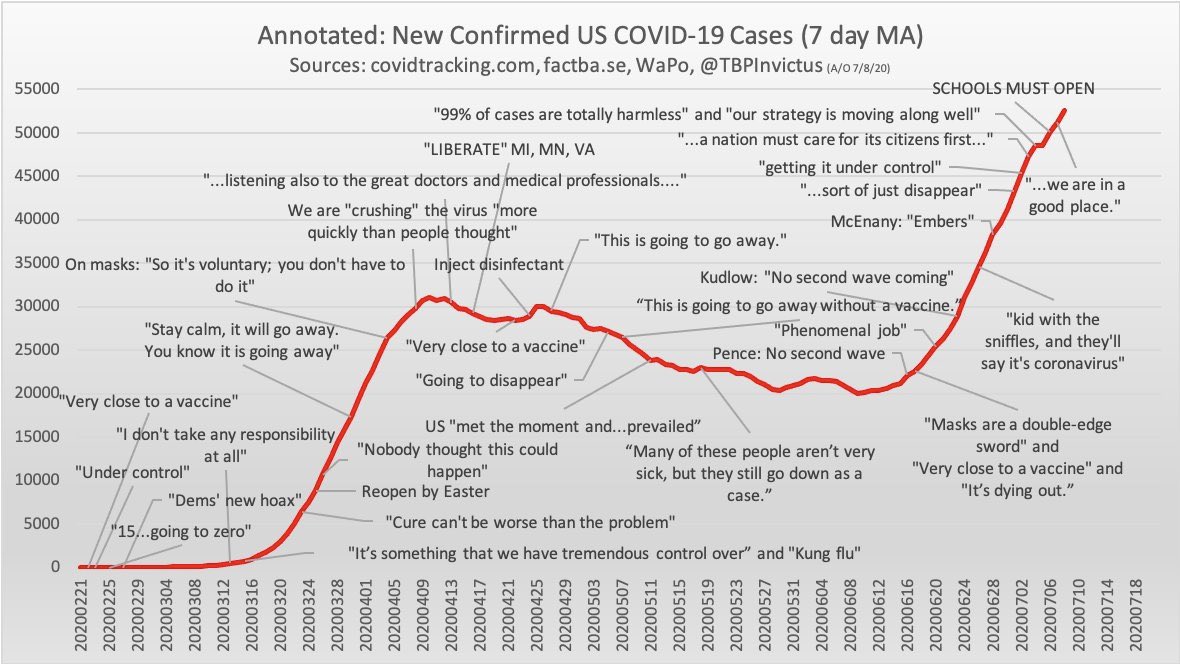
Source: The Lincoln Project
Cool article about digitized tapes of Grateful Dead concerts on Archive.org!
Wiki resources
I had a collection of links on wikis, thought I would collect them here:
Tom Critchlow – Building a Digital Garden: How I built myself a simple wiki using folders and files and published using Jekyll (his personal wiki)
I liked this article because it makes it possible to have a wiki without a database
Tom Critchlow – Of Digital Streams, Campfires and Gardens – Building personal learning environments across the different time horizons of information consumption
Tom gives Twitter, blogging, and wikis as his examples for his title, also references the article below.
Mike Caufield – The Garden and the Stream: A TechnoPastoral
This 2015 article compares and contrasts wikis and blogs, with a focus on Federated Wiki (created by Ward Cunningham)
Frank McPherson – Site index page for his instance of Federated Wiki (also, his page on setting up Federated Wiki on your laptop)
Andy Sylvester – My instance of Federated Wiki (my New User Setup page)
Rudimentary Lathe – Jack Baty’s hosted instance of TiddlyWiki
TiddlyWiki – Main site to download your own copy
Chris Aldrich – Summary of Indieweb pop-up session on The Garden and The Stream (includes notes and video)